| Author's
Note
|
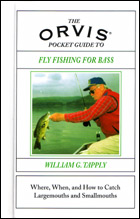
The Orvis Pocket Guide to Fly Fishing for Bass
|
| Excerpted from the Introduction: Black bass -- largemouths and smallmouths -- are native
only to North America. Today, after decades of transplanting and centuries
of natural migration, they thrive in all of the lower forty-eight states.
Very few Americans need to drive more than an hour to find decent bass
fishing. Virtually every weedy pond, rocky lake, man-made impoundment,
lazy creek and big river in America harbors a healthy population of naturally-reproducing
largemouths or smallmouths. Many waters hold both. Bass have become America’s
most popular game fish, and with good reason. They strike aggressively,
fight hard, jump eagerly, reproduce wantonly, and grow large. Bass eat any living thing they can catch -- insects, worms, lizards, crustaceans, other fish, even an occasional small animal or bird. When he’s in an eating mood -- as he generally is -- a hungry bass rarely snubs his nose at anything that’s digestible -- or that even looks digestible. You can catch bass on just about any fly you tie to the end of your line. High-tech bass fishing has become a big business in America. If you’ve ever tuned in a Saturday-morning cable channel, you know what I mean. The professional bassers would lead you to believe that if you want to catch bass, you need a fistful of rods, a steamer trunk full of lures, a streamlined bass boat built for speed, with a big motor on the transom, a foot-operated electric motor up front, a live well, and an electronic fishfinder. Everybody’s entitled to his own version of fun. But when I go bass fishing, I just rig up my fly rod, tie on a generic streamer or floating bug, climb into my canoe or float tube, and cast into the shallow water where bass like to go hunting. I suppose there are times when I might catch more bass or bigger bass with crankbaits or buzzbaits or spinnerbaits or stickbaits, but I usually catch enough bass on flies to satisfy me. This book isn’t about catching the most or the biggest bass. This book is about the fun of using a fly rod to cast lightweight lures made from feathers and fur for bass -- which is probably the oldest form of hook-and-line fishing in North America. It’s a quiet, low-tech, unhurried, non-competitive, uncomplicated method of fishing, and it always surprises me to meet devout fly-rod anglers who’ve never tried it.
|
|
|
Contact
Webmaster |
|